Monday, March 25, 2013

Holy Week


Yesterday marked the beginning of Holy Week, the week where Christians celebrate the passion, death, and Resurrection of Christ.

The main days of the week are Palm Sunday, which we celebrated yesterday, Holy Thursday, Good Friday, and then Easter Vigil on Holy Saturday night, and Easter Sunday itself. The Thursday, Friday, and Saturday, make up the liturgical season called the Triduum.

It is always fascinating to look at the liturgy for these days, and later on in the week I will tell you a little about the beautiful liturgies the Catholic Church will be celebrating. But for now I would like to tell you a little bit about what it means to me personally.

This week, I see Jesus at His most human. He experiences the cheers of the crowd at a time when it seems nothing can possibly go wrong, but we also see Him at His lowest, rejected, abandoned, murdered. In our own lives, we face situations where we experience comparable emotions. We feel like we are on the top of the world, everything is going right. And then things crash. We wonder where it all went wrong, why this is happening to us. It may seem that everyone has abandoned us, or worse, totally turned against us. We may even feel that this is the end. In some situations, people may even wonder what they have left to live for.

Jesus experienced all of this during the first Holy Week. He rode in triumph into Jerusalem, the people waving palm branches and cheering for Him, believing Him to be the Messiah, long-awaited by the Jewish people. However, by the end of the week, the cheers of “Hosannah” turn to shouts and jeers of “Crucify him! Crucify him!” The closest friends of Jesus, His Apostles, are nowhere to be found. He is forced to face His death completely alone. Where did it all go wrong? What did He do to deserve this? One moment He is at dinner with his disciples, and it seems like, the next moment, He is dying on a cross.

We can follow each moment of this week, and take the pain in our life, and we can unite it with His sufferings. The good news of all of this, as we know, is that the story did not end with His death. A far greater moment is yet to come. And we can pray and believe that it will come in our own lives, too. But we must travel with Jesus through all the pain to get there.

Sunday, March 24, 2013

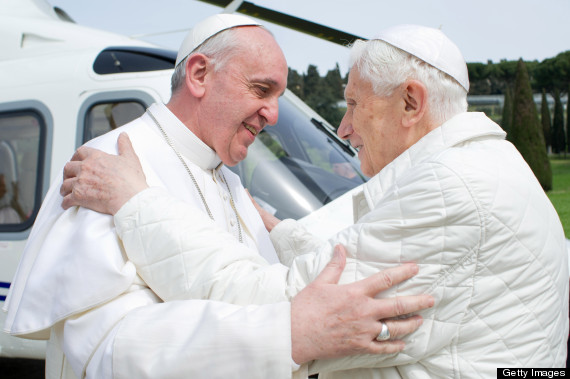
Pope Francis and Pope Emeritus Benedict XVI

Francis and Benedict XVI meet at the helicopter pad at Castel Gandolfo,
 the papal summer  residence.

Yesterday Pope Francis met with Pope Emeritus Benedict XVI for around two hours. This meeting was very historic. Benedict was the first pope to retire in six centuries; normally, a new pope would never have the opportunity to meet his retired predecessor, as his predecessor would have passed away.

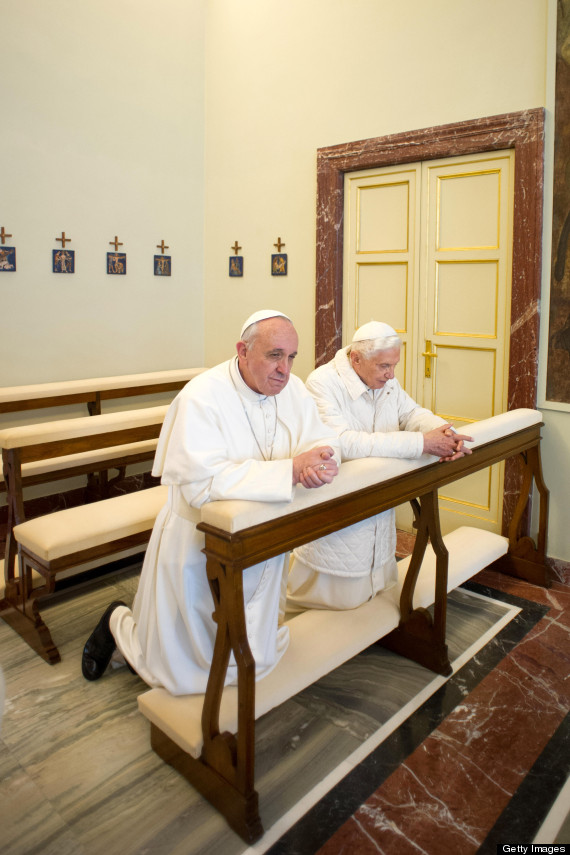
Francis also brought a gift to Benedict, an icon known as the “Madonna of Humility.” Immediately upon Francis’s arrival at Castel Gandolfo, the two went to pray together in a small chapel.


Together in prayer

Benedict at first offered Francis a special kneeler traditionally used by the pope, but Francis insisted that they pray together in the same pew. He is quoted as saying “We are brothers.”


The two had a private meeting that lasted about forty-five minutes, and Benedict renewed his vows of obedience and reverence to his successor, while Francis thanked Benedict for his service to the Church and his humility. The two are said to have abstained from formal titles and addressed each other familiarly.

Truly this is a good sign for the smooth passage of succession in this very strange and historic time for the papacy and the Church as whole! Many people want Francis to do many things in the coming months, and there are many problems that he has to address. After a few months, Benedict will return from Castel Gandolfo to the Vatican and reside in a monastery in the Vatican gardens. He will be a short walk away from St. Peter’s Basilica.

Saturday, March 23, 2013

How to Get from Peter to Francis: a SHORT History of Papal Elections


A few days ago I told you about the biblical basis for the papacy. Now let’s look at how we got from St. Peter to Pope Francis.
The process of choosing a pope has changed drastically over the years to fit the needs of an ever-growing Church. Back in the days of Peter, the Church quickly centralized in Rome, as the seat of the Roman Empire. Rome remains, to this day, the seat of the Church.

In the early Church, which was under constant persecution, the popes were mainly obscure figures who were able to do what it takes to keep the underground Church going. Eventually the Roman Empire came to accept Christianity, but unfortunately that also meant that secular authorities influenced, if not completely controlled, papal elections.

In 1059, Pope Nicholas II limited participation in papal elections to the College of Cardinals. While this did not entirely end external influence, it did make it a bit harder for rulers to directly influence the outcome of a papal election. It was the first step towards the system that the Church has in place today.

In the year 1274, the Second Council of Lyons was convened in order to regulate the papal election process. The major decree issued by the council was that all electors must meet within ten days of the pope’s death, and that they had to stay secluded until a new pope was chosen. The major driver behind this change was a three year vacancy after Pope Clement IV’s death in 1268. During that sede vacante, the Latin term for the interregnum period between papacies, the faithful Catholics had to take desperate measures to pressure the cardinal electors into actually choosing a pope. First they locked them all in, where only those cum clave, or with a key, could come in or out (this is the root of the word conclave), and then began rationing their food. When those methods failed, the faithful actually tore the roof off of the chapel they were sequestered in, exposing the cardinals to the elements. Finally, they had a pope. The strict time limit would later be slightly relaxed later in church history.

The Western Schism between 1378 and 1417 saw a very complicated situation emerge. Multiple anti-popes challenged papal authority in Rome, and were installed simultaneously in Avignon, France.

By this time, the papal election process largely resembled the modern process. Until 1621, many votes for the papal election were done by acclamation; that is, voice votes. However, 1621 was the last time that this occurred. Pope John Paul II formally abolished vote by acclamation, and all elections since then and henceforth will be by a full vote by ballot of the College of Cardinals.

And that is how we get from Pope Peter to Pope Francis!

Friday, March 22, 2013

"Go to the Foot of the Cross"


A priest I knew when I was a child always used to say, “On Fridays, go to the foot of the cross.” He would repeat this literally every Friday.

It was really a quite profound thing to think about. We all have crosses in our own lives that we need to carry. Every week it is important to take some time to think about Him whose example we are called to follow in bearing those crosses.

The mysteries of the passion and death of Christ are at the center of our faith as Christians. There is no escaping the cross, for without it there would be no point to Christianity. You can’t have Christ without the cross.

In the last days and hours of Jesus, He experienced many of the emotions that we are faced with at various times in our life. He was betrayed, and He felt abandoned, totally alone in the world. He knew sorrow, loneliness, pain, all those things we experience and find so hard to bear.

I just want to ask you today, to take some time to reflect on that. Think about your own life, what situations you are facing there. Then take that situation, and go to the foot of the cross.

Thursday, March 21, 2013

Pope Francis's first Angelus address


This is the text of Pope Francis’s Angelus address from Sunday, March 17, 2013:

“Dear brothers and sisters, good morning! After our first meeting last Wednesday, today I again give my greetings to you all! And I am happy to do it on Sunday, the Lord's Day! This is beautiful and important for us Christians: to meet on Sunday, to greet one another, to talk as we are doing now, in the square. This square that, thanks to the media, takes on worldly dimensions.

In this Fifth Sunday of Lent, the Gospel presents us with the story of the adulterous woman whom Jesus saves from being condemned to death. It captures Jesus' attitude: we do not hear words of contempt, we do not hear words of condemnation, but only words of love, of mercy, that invite us to conversion. 'Neither do I condemn you. Go and sin no more!' Well, brothers and sisters! God's face is that of a merciful father who is always patient. Have you thought about God's patience, the patience that He has with each of us? That is His mercy. He always has patience, is always patient with us, understanding us, awaiting us, never tiring of forgiving us if we know how to return to him with a contrite heart. 'Great is the Lord's mercy', says the Psalm.

In these days, I have been able to read a book by a cardinal—Cardinal Kasper, a talented theologian, a good theologian—on mercy. And it did me such good, that book, but don't think that I'm publicizing the books of my cardinals. That is not the case! But it did me such good, so much good... Cardinal Kasper said that hearing the word mercy changes everything. It is the best thing that we can hear: it changes the world. A bit of mercy makes the world less cold and more just. We need to understand God's mercy well, this merciful Father who has such patience... Think of the prophet Isaiah who asserts that even if our sins were scarlet red, God's love would make them white as snow. That is beautiful, [this aspect of mercy]. I remember when, just after I was made bishop, in 1992, the Madonna of Fatima came to Buenos Aires and a large Mass for the sick was celebrated. I went to hear confessions at that Mass. Near the end of the Mass I got up because I had to administer a confirmation. An over 80-year-old woman came up to me, humbly, very humbly. I asked her: “Nonna,” [grandmother]—because that's how we address our elderly—“Nonna, you want to confess?” “Yes,” she told me. “But if you haven't sinned...” And she said to me: “We have all sinned...” “But perhaps the Lord will not forgive you...” “The Lord forgives everyone,” she told me, with certainly. “But how do you know that, ma'am?” “If the Lord didn't forgive everyone, the world would not exist.” I wanted to ask her: “Tell me, have you studied at the Gregorian [Pontifical University]?”, because that is the wisdom that the Holy Spirit gives: the inner wisdom of God's mercy. Let us not forget this word: God never tires of forgiving us, never! 'So, Father, what is the problem?' Well, the problem is that we get tired, we don't want to, we get tired of asking forgiveness. Let us never get tired. Let us never get tired. He is the loving Father who always forgives, who has that heart of mercy for all of us. And let us also learn to be merciful with everyone. Let us call upon the intercession of the Madonna who has held in her arms the Mercy of God made human.”

Wednesday, March 20, 2013

The Role of the Papacy


As I have mentioned and made a few posts about previously, the Catholic Church has a new Holy Father. This raises some important questions about the role of the papacy, the basis for it, and how it applies to the lives of Catholics throughout the world.

First of all it is important to look at the basis for why we have a pope. We here the pope spoken of as the “successor of St. Peter.” But what does that really mean? How did Peter come to be the first pope, and how is Pope Francis, the current pope, his successor?

The answer to the first of these questions is found in Scripture. In Matthew 16:13-20, Jesus asks the Apostles, “Who do men say that I am?” The disciples answered that some said He was John the Baptist or Elijah or Jeremiah or one of the other great prophets of the Jewish tradition, returned from the dead. Jesus then asks them, “What about you? Who do you say that I am?” (Italics added for emphasis). Now, none of the Gospel accounts of this exchange actually say this, but I imagine that the Apostles all stopped and probably looked around at each other nervously. Throughout the ministry of Jesus, even though these men all lived with Jesus, travelled with Him, were with Him constantly, they never truly understood all that He was saying. It took the fulfillment of His earthly mission, through His death and Resurrection, for them to fully grasp the answer to this question of who Jesus really was. So it must have been a difficult moment, being put on the spot like that. Finally, one man, Simon, spoke up and said, “You are the Messiah, the Son of the living God.” Jesus answered, “Blessed are you, Simon, son of Jonah, for flesh and blood has not revealed this to you, but my Father who is in heaven. And so I say to you, you are Peter, and upon this rock I will build my church, and the gates of the netherworld shall not prevail against it. I will give you the keys to the kingdom of heaven. Whatever you bind on earth shall be bound in heaven; whatever you loose on earth shall be loosed in heaven.” This is why keys are a major symbol of the papacy. In this passage, Jesus appoints Peter as the head of His church, vesting him with the responsibility to be the earthly leader of all of Christ’s followers.

Other passages of Scripture serve to further explain the role of the pope in the Church. The first instance of this is actually when Jesus calls Simon Peter to follow Him. He says, “Come after me, and I will make you fishers of men” (Matthew 4:19).  Peter had, of course, been a fisherman by trade before he was called to be a follower of Christ. The pope, as head of the Church, must always be looking for new ways to spread the Gospel message. This is the call of all members of the Church, but the Holy Father hears this call in a special way. It is his example that the rest of the Church follows.

One other passage I would like to speak about comes in John’s Gospel, 21:1-19. It is one of the post-Resurrection appearances of Jesus. Seven of the disciples, among them Peter, went fishing. They were out all night, but caught nothing. At dawn, Jesus came to them on the seashore, and asked if they had caught anything. He then ordered them to cast their nets on the other side of the boat, and upon doing so, they caught a multitude of fish. Peter then realized that it was Jesus who was speaking to them, and he then jumped into the sea and swam to the shore, so great was his joy at seeing Jesus again. The disciples then cooked breakfast out of the fish they caught. After breakfast, Jesus takes Peter aside, and asks him three times, “Do you love me?” Peter, of course, answers yes. It was a greatly troubling question for Peter, as it reminded him of how, on the night Jesus was arrested, Peter had three times denied even knowing Jesus. However, each time Peter answered that he loved Jesus, Jesus gave him an order. “Feed my lambs.” “Feed my sheep.” This command reaffirmed for Peter that he was to be the spiritual leader of all the followers of Christ, that he would be the one looked to for guidance and spiritual nourishment. To this day, Catholics continue to listen closely to the words of the Holy Father, as his teaching helps us to understand all that Christ taught us, and helps us to apply that message to our daily life.

In a future post, I will talk more about how we got from Peter, our first pope, to Pope Francis, our current Holy Father. But until then, please remember to say a prayer for our Holy Father, as he has repeatedly asked.

Tuesday, March 19, 2013

Feast of St. Joseph


Today is the Feast of St. Joseph, husband of the Blessed Virgin, foster-father of Jesus, and the Protector of the Universal Church. The Gospels do not record any of his words, but he is very prominently featured in the infancy narrative of St. Matthew’s Gospel. In fact, he plays a pivotal role. Three times in that Gospel, an angel comes to him in a dream, and his obedience to the messenger of God secures the safety of his family.

The first time, he is told to take Mary as his wife. He had been about to divorce her quietly, because she had been found to be with child. He was a righteous man, he did not want her put to death, but as an observant Jew, he did not want to be living in an immoral situation. An angel came to him, telling him, “Joseph, descendant of David, do not be afraid to take Mary to be your wife. For it is by the Holy Spirit that she has conceived. She will give birth to a son and you will name him Jesus -- because he will save his people from their sins” (Matthew 1:20-21).

The second time the angel comes to Joseph in a dream is after the birth of Jesus. The Holy Family is in Bethlehem, and up in Jerusalem, King Herod the Great has just learned that he has been deceived by the three wise men from the East who had come to the land of Judea, following a star that they believed foretold the birth of the Messiah, one that will lead God’s chosen people into a new kingdom. Herod had hoped that these wise men could lead him directly to that child, so he could destroy that child. However, an angel had warned them in a dream not to return to Herod. Upon realizing that there was now no way to know which individual child was the fulfillment of the prophecy that was made concerning this Messiah, he ordered the slaughter of all boys in Bethlehem and the surrounding area two years of age and younger. Once again an angel appeared to Joseph in a dream, warning him of this, and telling him to take his family into Egypt, where they will be safe. At once, Joseph got up, woke up his family, and off they went into Egypt.

Eventually King Herod died. One final time, an angel came to Joseph, this time, to tell him that it was safe to return to Israel. Once more, Joseph obeyed immediately.

Joseph is mentioned one final time in the Gospels, this time, in the Gospel of Luke. Jesus is twelve years old, and the family had gone up to Jerusalem to celebrate the Passover feast. On the way back, as was customary, Mary and Joseph were travelling in separate groups, Joseph with the men, and Mary, with the women and children. Jesus could have been with either group, and both assumed he was with the other. Eventually they realized he was with neither, so they back-tracked all the way to Jerusalem. Eventually they found Jesus in the temple, speaking with many learned men. The Blessed Mother asked, “‘Son, why have you done this to us? Your father and I have been terribly worried trying to find you.’ He answered them, ‘Why did you have to look for me? Didn’t you know I had to be in my Father’s house?’” (Luke 2:48-49). There is more than meets the eye to this apparent snub to the parenthood of St. Joseph, for the Gospel goes on to say that he “went back with them to Nazareth, where he was obedient to them” (Luke 2:51). Nothing more is mentioned of his childhood, but it is believed that Joseph taught Jesus his trade, carpentry.

St. Joseph, pray for us!